

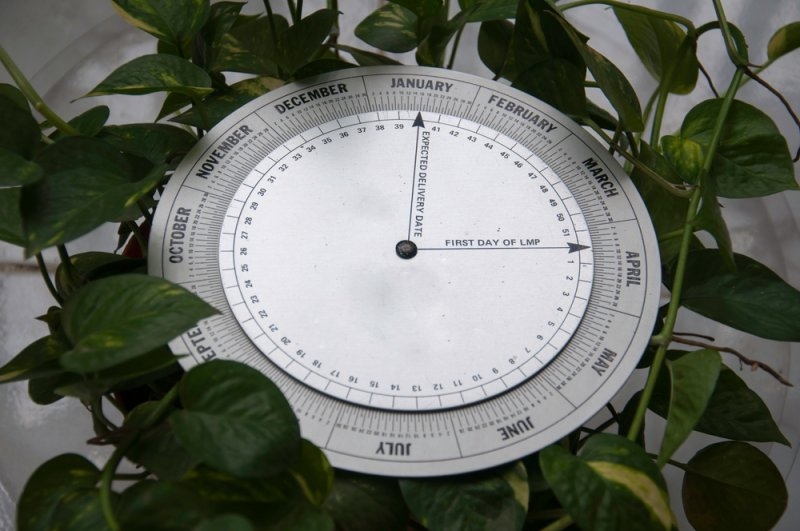
A pregnancy due date calculator gives you an idea of when your baby could show up, so you can start planning the next few months. You enter the first day of your last period or the date you conceived, and the calculator does the rest. Knowing your estimate helps you keep up with prenatal appointments, work out leave with your job, prep your hospital bag, and loop your family in.
Still, no tool can nail down the exact day you’ll go into labor. Pregnancy lengths aren’t the same for everyone, and details like your first ultrasound might shift your estimate. In this post, you’ll learn how these calculators work, how to use the date they give you, and how to get ready along the way.
Established dating methods, used in a pregnancy due date calculator, estimate when a pregnancy might reach 40 weeks.
A regular due date calculator will give around 280 days or 40 weeks from the first day of the last period (LMP). This technique assumes that the period lasts for 28 days and that the ovulation date is on day 14.
Based on this information, a "Pregnancy Calculator" can be used to calculate the due date as well as the stage of the pregnancy. For some, however, the process of ovulation occurs on the same day. This is a beginning, but not a final medical finding.
Work out the due date for your last period: Jot down the last day of the last period (from which the bleeding stopped doesn't count). Count 280 days to find the due date.
For instance, if you were in your first period on 1st January, you would be expecting your period to come on sometime around 8th October for a non-leap year. This is a representation of the 280-day dating, which may vary based on the cycling period and clinical results.
An estimated due date calculator will give you an estimated due date, and a pregnancy weeks calculator will help you determine today's pregnancy measurement. Pregnancy is typically dated from the first day of the woman's last period.
| Tool | Main purpose | Information needed |
|---|---|---|
| Pregnancy due date calculator | Estimates arrival date | Last period or conception details |
| Pregnancy weeks calculator | Estimates current gestational age | Last period and current date |
| Conception date calculator | Estimates timing from conception | Known or estimated conception date |
| Baby due date calculator | Supports arrival planning | Pregnancy dating information |
The tools can help to make dates more understandable; however, the pregnancy timeline should be determined by a health-care provider.
Must Read: Pregnancy Fatigue Relief Tips: Energy-Boosting Strategies
The technique applied is the concern, as the final period and conception date are not necessarily in the same time frame.
It is common to use the date of the last period as the due date since it is easy to calculate when a person's last period began. This is the estimated due date of 40 weeks after that date.
This may not be as reliable if there are any irregular cycles, if the woman has recently used hormonal contraception or has had children and is breastfeeding, or if the date of the period is uncertain. Then, the initial estimate may have to be amended following clinical assessment.
The best time to use a conception date calculator is when there is a reasonably good idea as to the conception date. The estimated due date is roughly 266 days backward. Since pregnancy is approximately 38 weeks from conception, it is approximately 266 days later.
If you conceive around Feb 1, then you will be due on around Oct 25. This is an estimate. However, even if a person knows when she was ovulating and fertilized, she will not know the exact dates.
The everyday LMP isn't always precise if the periods are irregular, as it is possible that ovulation could occur earlier or later. It is hard for a pregnancy due date calculator to accurately determine a pregnancy due date based on the period date, because the period date does not give a reliable idea of a woman's cycle.
An early ultrasound could provide a clinician with a better estimation of gestational age. Don't re-enter the due date on the history record at every appointment; share any known dates with the chart holder.
Top Pick: Best Healthy Pregnancy Nutrition Basics For Mother and Baby
Having an idea of which week you are in can help you know what's going on with your pregnancy, and it helps to prepare for the appointments and changes that you might experience.
When you are asking, “How many weeks pregnant am I?” then add each date together to see how many weeks are between the first day of the last period and your date! The time elapsed is converted to weeks and days.
If, for instance, you've had 63 days since you first noticed your period, your LMP dating on top of that would mean you're about 9 weeks in. This calculation may be simpler with the help of one of the pregnancy weeks calculators but could be subject to change with the help of an ultrasound.
Pregnancy is typically expressed as weeks and days, e.g., 9 weeks and 3 days. This is 9 weeks, plus 3 more days.
While the estimate can be valuable for monitoring prenatal milestones, it shouldn't be interpreted as knowledge of the time of conception itself, 9 weeks ago. The gestational age is typically calculated as being the time elapsed from the LMP, considering the period typically taken for a female to conceive (about 2 weeks).
The use of a pregnancy due date calculator offers a good estimate, but its accuracy will vary based on the information entered into the calculator and when an assessment is performed.
If the last period is uncertain, cycles vary, and/or ultrasound dating indicates a different gestational age, the initial date may be adjusted. The information available from the study will be used by clinicians to draw the most appropriate conclusion.
Few infants are delivered on their actual "due" date. The date should be viewed primarily as a reference, rather than a deadline.
Due date estimation is based on information regarding the age of the embryo and the date of its transfer following IVF. The estimated due dates are: day five embryo transfer is generally 261 days after transfer, and day three embryo transfer is generally 263 days after transfer.
Your fertility clinic can verify this calculation using your distinct details of treatment. If you don't specify the details correctly in a general pregnancy date calculator, it may not calculate them correctly.
After getting an approximate date, plan any daily activities around it, keeping in mind that practical things may not change, but you should not assume that the baby will be arriving on time.
A baby due date calculator gives you a good idea of when your baby might arrive, so you can plan. Here’s what you’ll want to go over with your healthcare provider:
Stay flexible. Try to have the big things finished before you hit those final weeks, because babies don’t always stick to the schedule.
Don’t miss: Top Pregnancy Myths You Should Stop Believing
Basically, a due date calculator takes a fuzzy timeline and turns it into a practical starting point. It gives you a ballpark for your baby’s arrival, how far along you are, and when to expect key milestones. You just need to plug in accurate info and know that if your cycle is irregular or you used IVF, you’ll want your doctor to confirm things.
Use the calculator’s date to organize plans, not pin down when labor starts. Check in with your healthcare team regularly, and update your prep as things move along. Planning is smart—but being flexible is just as important.
No, that's not what it does; it just approximates when. If you're interested in finding out your child's gender, an ultrasound or other specialized prenatal testing is required.
Nope. Your doctor will review your ultrasounds and history and determine whether your date needs to be adjusted. Check with the person before changing dates.
Generally, twins are also dated the same way, although the delivery date is slightly different. Your doctor will inform you about what to look for.
You can work out dates by your period, but you still need a medical diagnosis to know if you are pregnant or not. If you’re unsure about the result, ask your doctor.
It's not guesswork; if you are uncertain, your doctor can use an ultrasound and other information to determine how far along you are.
This content was created by AI